Solar sites, battery storage, and critical facilities are maintained by contractors and subcontractors across locations that are often unattended. Completing the work is only part of the task; the record must also demonstrate that it was done.
Few contractors will create an account, install an app, and complete onboarding for a single job. The work therefore takes place outside the maintenance system and returns as photographs in a WhatsApp thread.
That arrangement becomes a problem when an asset owner disputes a response time or an auditor requests twelve months of preventive-maintenance records. The evidence may be buried in a chat history, or may never have been captured.
Per-seat licensing is often what prevents field work from reaching the system of record.
A subcontractor receives a link to the work order, completes the checklist, and attaches photographs. No licence, app, or account is required. The completed work returns as a structured record against the asset.
Licence-free mobile work orders for employees, subcontractors, and third-party crews. When a provider delegates work to another subcontractor, the chain remains visible, showing who completed the work as well as who submitted the invoice.
Each work order creates an audit trail of photographs, readings, timestamps, checklists, and sign-off. Evidence packs for asset owners and auditors are produced from the information captured when the job closes.
Manage an asset hierarchy across hundreds of sites and multiple owners, pool spare parts across locations, schedule preventive maintenance by runtime, and integrate with ERP, MES, and SCADA systems. Facterra runs in our cloud or on your own servers and can go live in weeks.
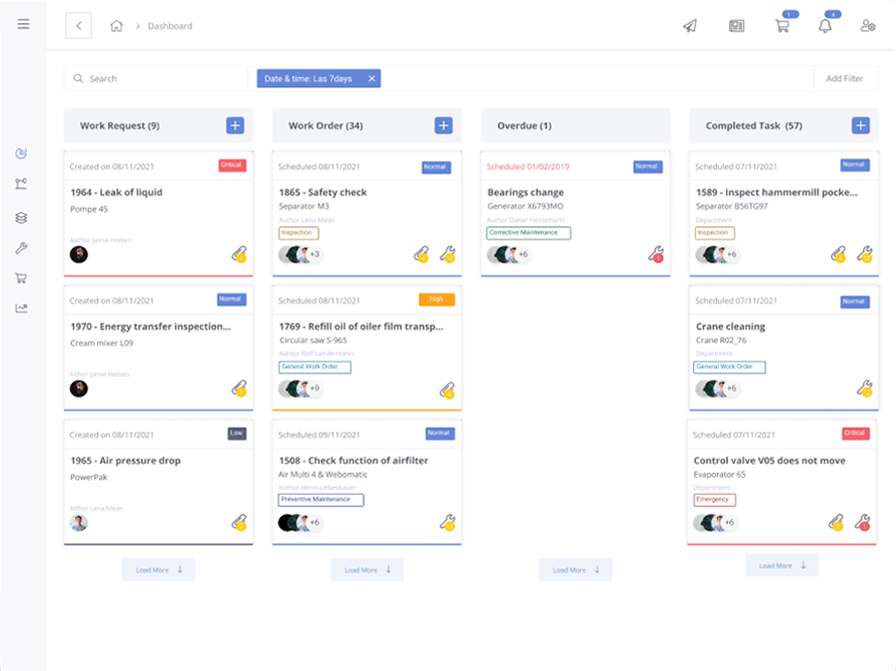
See requests, scheduled work, overdue tasks, and completed work across every site you maintain, together with the owner and crew assigned to each job.
The Facterra maintenance board, showing requests, scheduled work, overdue tasks, completed work, and assigned crews.
Facterra captures the supporting evidence as jobs close, including certificates, readings, signatures, and photographs. The evidence pack is therefore available when an asset owner disputes an SLA or an auditor requests it.
Facterra does not create missing evidence. A missing signature remains visible, allowing the team to address the gap.
| Work order | Asset | Closed | Evidence captured |
|---|---|---|---|
| Quarterly inverter service WO-8612 |
INV-B02-014 | 12 Jun A. Whitcombe · SUB |
6 photos4 readingsSignature
14:22 · geotagged
|
| Thermography — combiners WO-8571 |
Block A–D | 04 Jun J. Moreau |
IR report28 scansSignature
09:05 · geotagged
|
| MV switchgear inspection WO-8498 |
SWG-01 | 22 May E. Kowalski · SUB |
Certificate3 photosNo signature
11:47 · geotagged
|
| Module cleaning — Block C WO-8455 |
SITE-KR2 | 15 May R. Halvorsen · SUB |
12 photosBefore/afterSignature
16:30 · geotagged
|
Interface mockup — representative data, not a customer record.
| Asset depth | Speed & cost | Field execution | |
|---|---|---|---|
| Maximo, SAP PM, Infor | Deep | 12–18 months, enterprise price | Per-seat, weak mobile |
| Limble, UpKeep, MaintainX | Single-building | Instant, cheap | Per-seat, app + onboarding |
| Monitoring platforms | Performance, not maintenance | — | Not their job |
| Facterra | Full hierarchy, multi-site | Weeks | Licence-free links |
Maximo's asset model, without Maximo's cost or implementation timeline.
Facterra is designed to sit within an existing technology stack, rather than replace it. It holds the asset, work, parts, and evidence records, and its API allows connected systems to access the information they require.
Scheduling is one example. Facterra integrates Timefold's optimisation engine. Crews, skills, parts, permits, and production windows inform a schedule that is then managed in the same application as the work itself.
Facterra has managed industrial assets since 2017 and has been deployed at more than 50 facilities across North America, Europe, and Asia, including dairies, breweries, steel plants, water-treatment sites, and an ethanol producer.
These are environments with demanding equipment, variable connectivity, and technicians who have little time for another application.
The asset model applies across industries. A string inverter on a preventive-maintenance schedule, under warranty, with an owner requesting proof of service has the same underlying record requirements as a homogeniser in a dairy. Distributed infrastructure differs because the site is unmanned and the technician is usually a subcontractor.
“The tracking of activities in case of an audit, both internal and external — all information is easy to extract. You can look at the history of each piece of equipment, tracing all the activities that have been done on it.”
Dustin Gibbons — Production Manager, Prairie AquaTech
“It is clearer to have everything in one programme than to open three different things. And especially with machines, you want to have a history.”
Jörn Möller — Leiter Technische Werkstatt, Molkerei Rücker
Technicians spend much of their day on administrative work rather than on tools. We are building an EAM to help with that work: raising orders, suggesting causes, coordinating parts, and assembling evidence.
The system can suggest; a named person remains responsible for sign-off.
Facterra is an enterprise asset management system for maintenance and compliance execution in distributed critical infrastructure. It is designed for organisations maintaining assets across sites they neither own nor staff directly, including renewable-energy O&M contractors managing solar, wind, and storage portfolios, and teams responsible for critical facilities such as data centres. It manages work execution, subcontractor dispatch, and the evidence required by asset owners and regulators.
Traditional CMMS and EAM systems generally assume that work is completed by employees with named licences. In distributed infrastructure, much of the work is completed by subcontractors, so records often remain in WhatsApp messages, spreadsheets, and PDFs rather than in the maintenance system.
Facterra allows subcontractors to complete a work order from a link, without a licence, app, or account, so the record is captured where the work takes place. It also treats audit evidence as an output of completed work rather than a reporting exercise conducted later. Read more about subcontractor execution.
No. A subcontractor receives a link, opens it on their phone, and completes the work order, including readings, photographs, parts used, and a signature. No licence, app, or account is required. Facterra is licensed as a platform rather than per seat, so the cost does not increase with the size of the contractor network.
Not yet. Offline capture is in active development and will not be represented as available before it ships. Remote solar farms, wind sites, and plant rooms frequently have limited or no usable signal, so please ask for the current delivery status when you speak with us.
Yes. Facterra can be deployed in your own cloud tenancy or on your own servers. This matters for data-centre operators and asset owners whose security review does not permit an external multi-tenant system. Vendor-hosted deployment is also available. See critical facilities.
An evidence pack brings together the work orders completed, the people who performed them and their certifications, timestamped readings and site photographs, parts consumed, and task signatures. Because it is generated from the work record rather than compiled manually, it can be produced on demand for an asset owner, auditor, or insurer.
Facterra covers renewable-energy generation, including solar PV trackers, inverters, and combiners, wind turbines, and battery energy storage, as well as mechanical and electrical plant in critical facilities, such as standby generators, UPS systems and battery strings, chillers, CRAC units, and switchgear. It has supported industrial maintenance since 2017 and is now applied to renewables O&M and critical facilities.
A deployment takes weeks rather than a year. It includes a discovery workshop, migration of the existing asset and maintenance data, integrations, and training. The work is led by the product team rather than an implementation partner, and we take on a limited number of concurrent deployments.
Facterra is licensed as a platform rather than per seat, so the contractor network is not a separate line item and cost does not scale with the number of people who use a work order. Pricing depends on portfolio size and whether you self-host, and is quoted directly rather than published.
We take on a limited number of deployments at a time and lead them directly.
Deployment includes data migration, integrations, and training. You work directly with the people who build the product, rather than through a support queue. Licensing is by platform, so the contractor network does not become a separate line item.
We need a discovery workshop, access to the data you already hold, and a decision-maker who can commit. Go-live is measured in weeks rather than a year.
Facterra has supported industrial maintenance since 2017. We are now applying that experience to renewables O&M and critical facilities, while keeping the number of concurrent deployments limited because we lead them directly rather than handing them to an implementation partner.
We use Google Analytics to understand how this site is used. No advertising cookies, no cross-site tracking. See our Privacy Policy.