Product · in production since 2017

A full EAM, running in real plants for eight years.

Asset registry with real hierarchy, work orders on a board, preventive maintenance on hours run as well as dates, spare parts pooled across sites with purchasing behind them, documentation on the machine via QR, and subcontractors who complete work from a link. All of it in production, some of it for eight years.

This page shows the shipped product. The roadmap is at the bottom, clearly separated.
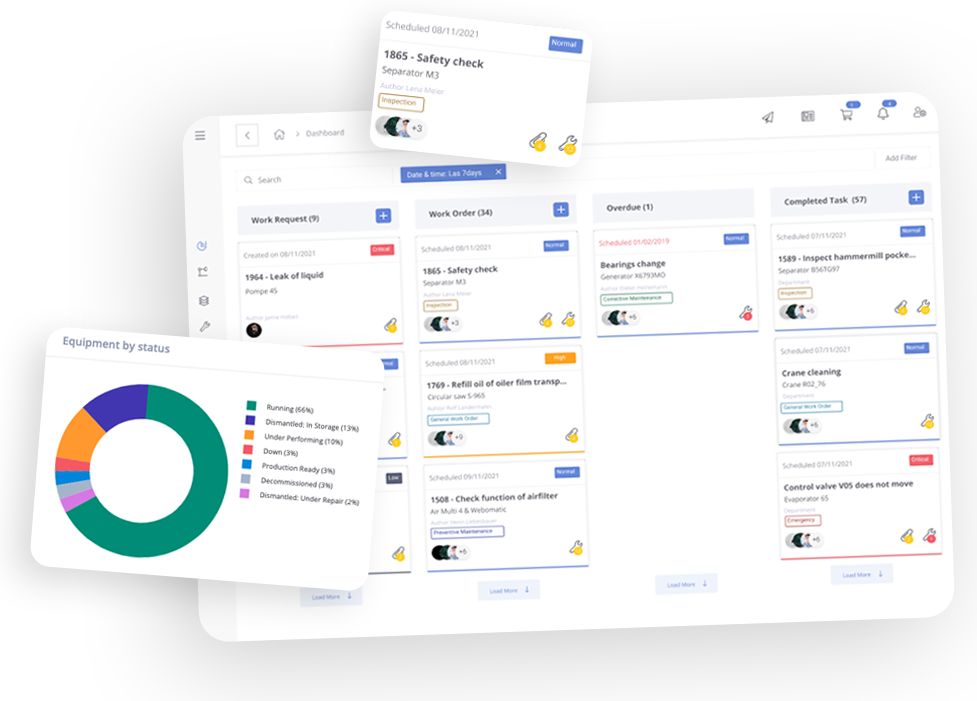
The Facterra maintenance board: columns for Work Request, Work Order, Overdue and Completed Task, with a work order card and an equipment-by-status breakdown shown alongside.
The equipment page

Everything about a machine, on one page

Every asset has a single page holding its identity, live meters and alerts, maintenance calendar and history, spare parts and bill of materials, and every document that belongs to it. A technician scans the QR code on the enclosure and lands here.

Assets › Redland Creek I › INV-B02-014Running
Type
String inverter
Manufacturer
SMA
Model
STP 110-60
Serial
3007841255
Criticality
High
Commissioned
03/2022
Warranty
03/2032
Newsfeed Monitoring Spare parts Maintenance Files Parameters
Calendar List Plans
ClosedWork orderTypeDone byEvidence
12 Jun Quarterly inverter service
WO-8612
Preventive A. Whitcombe SUB
6 photos4 readingsSignature
28 Apr Cooling fan replacement
WO-8407
Corrective J. Moreau
2 photosPart: fan kitSignature
09 Mar Thermography — DC terminations
WO-8231
Preventive E. Kowalski SUB
IR reportSignature

Interface mockup. Tabs and layout mirror the shipped equipment page; the data is representative, not a customer record.

The history survives the technician

Every job ever done on the machine, who did it, what parts went in and what evidence came back, attached to the asset rather than buried in a closed work order.

QR access at the machine

The code on the enclosure opens the record on any phone: history, manuals, drawings, safety checklists, open work. No searching, no asking the planner.

Warranty is a date on the record

Manufacturer, serial and commissioning date sit on the asset, so a claimable failure is visible as one while the claim is still worth making.

The register

A register with real hierarchy underneath it

Equipment, components and spare parts are first-class records in a parent/child tree: portfolio, site, block, equipment, component. Costs, failures and history roll up the tree, so "what is this string costing us" and "which inverters of this model keep failing" are queries rather than research projects.

Each record carries status, criticality, manufacturer, model, serial, commissioning date and any parameter you care to define. Status is visible at a glance across the whole estate.

The tree spans every site you maintain and every client you maintain it for, with each client's data separated at the database level and access scoped by role.

Assets › All sites214 assets
Redland Creek I · solar · 62 MW148
Block B36
INV-B02-014 · string inverterRunning
FAN-B02-014-2 · cooling fanRunning
CB-B02-3 · DC combinerRunning
TRK-B02-11 · tracker rowDegraded
Substation · SWG-019
Harwick BESS · storage · 40 MWh41
PCS-02 · power conversionFault
Dalton DC East · facility25
GEN-A01 · standby gensetRunning

Interface mockup — representative hierarchy, not a customer configuration.

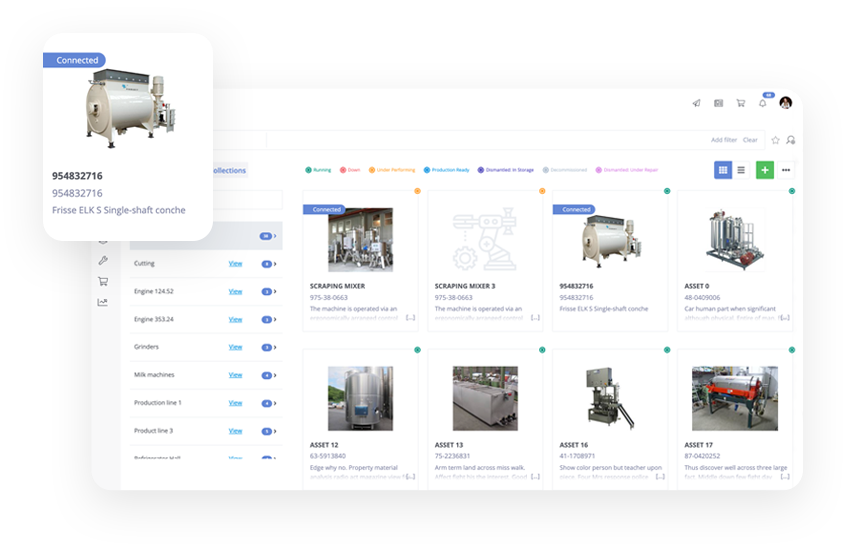
The Facterra asset register: tiles with equipment photography, tag numbers, live status colours and connection state, with the area tree in a left sidebar.

The register in Facterra today, captured in an industrial deployment. Equipment photography, tag numbers, live status and connection state on every tile.

Work execution

The whole week's work on one board

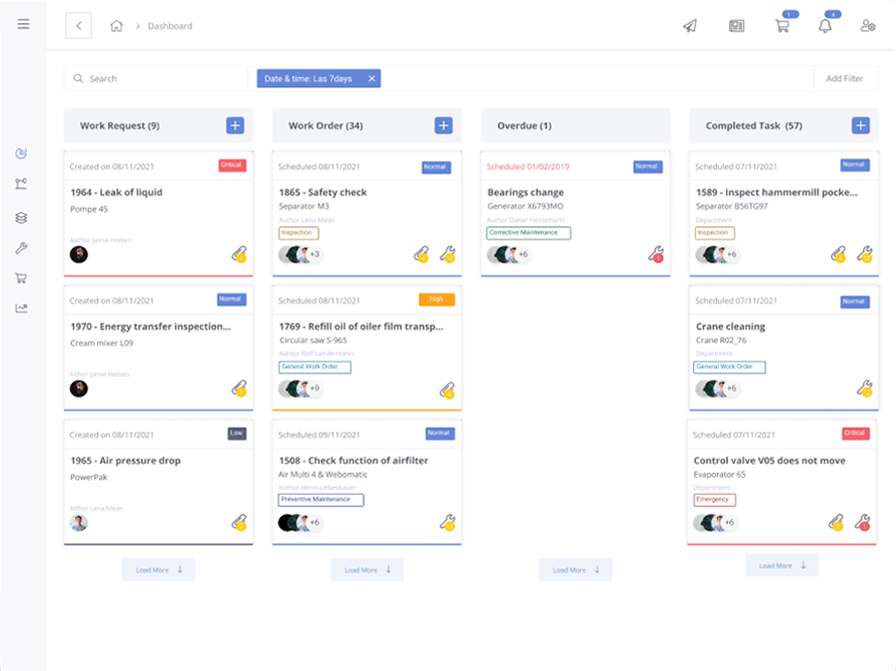
Requests come in from operators, alarms or inspections; the planner turns them into orders, assigns a crew or a subcontractor, and drags them through to done. Overdue work sits in a column everyone can see, rather than surfacing in a report at month end.

The Facterra maintenance board: four columns headed Work Request, Work Order, Overdue and Completed Task, each holding cards that show the scheduled date, priority, asset, work type and the crew assigned.

The board in Facterra today. Priority, work type, the asset and the crew on every card, with drag-and-drop that works on a tablet in the plant.

Three-stage lifecycle

Request, order, report. A completed job carries its post-completion report, so closing a work order means recording what was found, not just that someone went.

Dependencies and approvals

Jobs can depend on other jobs, and approval workflows gate the steps that need a decision — a cost sign-off, an engineering review — before work proceeds.

Assigned to people who aren't users

A work order can go to your own crew or to a subcontractor with no account, by link, and the completed record comes back either way.

Preventive maintenance

Maintenance triggered by hours run, not just the calendar

Calendar PM regimes are the baseline. On top of them, meters and counters feed triggers: a genset serviced every 500 running hours, a contactor inspected every 6,000 operations, a filter cleaned when differential pressure drifts. The rule fires, the work order raises itself against the plan, and the right people are notified by email, SMS or in the app.

Readings come from PLC counters, connected sensors and meters, or from a technician typing a number at the machine. Either way the reading lands on the asset, and the trigger doesn't care which route it took.

This is how plant that runs intermittently — standby generators, trackers, pumps — gets serviced on what it did rather than on how long it sat there.

Monitoring › Alert rules3 active · 1 paused
TriggerRuleThen 
Running hours
GEN-A01
Every 500 h Raise Oil & filter service
Notify: email + SMS
Switch count
ATS-2
Every 6,000 ops Raise Contactor inspection
Notify: in-app
Supply air temp
CRAC-07
> 27 °C for 15 min Alert, high priority
Notify: email + SMS
Diff. pressure
INV-B02-014
ΔP > 0.6 kPa Raise Filter clean
Notify: email

Interface mockup — the rule shapes mirror the shipped alert builder; representative assets, not customer data.

Inventory › Inverter fan kitBelow min at 1 site
LocationStockMinOn order
Redland Creek I — store02PO-2214 · due 18 Aug
Harwick BESS — container31
Central warehouse64
Required by WO-8711 · Quarterly inverter service · 21 Aug — stock at Harwick covers it.
Spare parts & purchasing

Parts pooled across sites, with purchasing built in

Stock levels with min/max thresholds per location, movement history, and one view of the same part across every site and van stock you run. Before anyone raises a purchase order, the system shows the sister site holding three on a shelf.

Purchasing is in the product, not bolted on: requisition, request for quotation, order, receipt. Purchase orders write back to your ERP where one exists, and parts consumed on a job land on the work order and the asset's cost history.

Parts attach to work orders and maintenance plans, so upcoming demand is visible against the shelf — and the Friday job doesn't die on Thursday because someone used the last seal kit on a breakdown.

Interface mockup — representative stock, not customer data.

Documents & checklists

The documentation lives on the machine

Manuals, drawings, certificates and safety checklists are stored against the asset, and the QR code on the enclosure opens them on whatever phone the technician is carrying. The single-line diagram is at the switchgear, not in a folder on someone's laptop.

Checklists run at the point of work: step by step, with readings and photos captured against each step and a sign-off at the end. The completed checklist becomes part of the asset's record — which is the raw material every audit and owner report is later built from.

Certificates carry expiry dates, so the lifting-gear cert that lapses in March is a warning in February rather than a finding in April.

facterra.app/a/inv-b02-014
Scanned · INV-B02-014
String inverter — Block B
Redland Creek I
PDFOperating manual — STP 110-6014 MB · rev 2024
DWGSingle-line diagram, Block Brev C · 03/2022
PDFLOTO isolation procedureapproved 05/2025
CHKQuarterly service checklist18 steps · 4 readings
LOGService history23 work orders since 2022
Scanned from the QR on the enclosure

Interface mockup — representative documents, not customer data.

Field execution

Subcontractors complete work orders from a link

Most of the work on distributed infrastructure is done by people who will never log into your system. Facterra sends them a work order as a link, by SMS or email. It opens on their phone with the asset, the history and the checklist; photos, readings and a signature come back attached to the record.

No licence, no app, no account — and the platform is licensed rather than the seat, so two hundred subcontractors cost you nothing extra.

Scoped access
The link opens one work order against one asset. Your HVAC contractor sees the chillers they service, not your estate.
Structured return
Checklist steps, readings, photos and sign-off land against the asset — not as attachments in a WhatsApp thread.
Every client separated
Each asset owner's data sits in its own database schema. Contractors serving competing owners keep them walled off.
Platform

Built API-first, deployed where your security review says

Facterra is a cloud-native web application with a REST API underneath every screen, which is why it integrates instead of importing spreadsheets. It runs in our cloud with EU, US or Singapore residency, in your cloud tenancy, or on your own servers.

Analytics ship with it: maintenance, purchasing and per-site views, configurable dashboards, shift reporting and data export. Deployments include dashboards built around how you actually report.

Integration
ERP for stock, purchase orders and SSO; MES and SCADA via API. Shipped in industrial deployments, not a connector list on a slide.
IoT & meters
Sensors, meters and PLC counters feed monitoring and runtime PM triggers.
Isolation
Schema-per-tenant separation at the database level, with role-based access on top.
Hosting
EU / US / Singapore data residency, your own cloud, or on-premise.
Languages
English, German, Spanish and French, across the product. Technicians work in their own language.
Deployment
A structured programme of up to sixteen weeks: discovery, data migration, interfaces, training. A two-hour training covers the basics for a technician.
Roadmap · in active development

Where the product goes next: taking the paperwork off maintenance

Technicians spend a large share of the day on administration rather than on tools. We're building the layer that does that administrative work — raising the order from a voice note, suggesting the likely cause with sources, chasing the parts, assembling the evidence. It suggests. A person signs.

Everything in this section is in development, not shipping. The split is listed plainly below.

Raises the work order

A tech speaks into their phone or sends a photo. It works out the machine, the fault and the urgency. Won't guess the asset — if it can't match it, it asks.

Suggests the likely cause

Readings beside every repair on that machine and its twins, a short list of causes, the parts to bring. Won't state a cause without showing the reading or past job behind it.

Builds the week

Crew, stock, permits and production windows go to a purpose-built solver; a schedule that survives contact comes back. Won't schedule a job with no part or no valid permit.

Chases the parts

Usage against lead times, stock held against planned jobs, the sister site checked before a purchase. Won't spend past your limit without an approval.

Assembles the audit pack

Certificates, readings, signatures and photos collected as jobs close. Won't create evidence — a missing signature stays missing, and stays visible.

Makes every PM justify itself

Each interval weighed against the failures it prevents, changes proposed as trials with success criteria. Won't touch a statutory task without a named approver.

Rules written by describing your plant

Say the rule in one sentence and it is compiled into something you can read line by line, edit, version and switch off. Before it goes live, it is back-tested against your last twelve months — "it would have fired forty-six times, here are all forty-six" — so you approve the rule you actually meant.

And the control model is fixed: it acts only on real assets and parts in your register, from a fixed set of moves, inside limits you set. Every entry shows its author, human or software, and reverses in one step. Anything carrying a regulatory or safety signature is signed by a named person, always.

Workflows › New ruleBack-test first
When
A trip is recorded on any asset in class Air Compressor
If
Two or more trips in a rolling seven days
Then
Raise inspection, high priority, to the shift engineer group
And
Hold line release until signed by someone with the Engineer role
Never
This can never stand in for an isolation permit signature
Back-test: would have fired 46 times in the last 12 months across 4 sites. Review all 46 →

Interface mockup of a feature in development — representative rule, not a customer configuration.

Common questions

Questions about the product

What does the Facterra EAM include today?

An asset register with full parent/child hierarchy across sites, work order management on a Kanban board, preventive maintenance on calendar and runtime triggers, meters and threshold alerts, spare parts with pooled stock across locations and a built-in procurement flow, document and checklist storage with QR access at the machine, subcontractor work order completion by link, analytics dashboards, and ERP, MES and SCADA integration via API. In production in industrial facilities since 2017.

How does Facterra use AI in maintenance?

On the administrative work around maintenance, not the engineering judgement inside it — raising the work order, suggesting a likely cause, chasing the parts, assembling the evidence. It suggests; a named person signs. That work is on the roadmap, described separately from what ships today.

Will AI sign off maintenance work or permits?

No. Anything carrying a regulatory or safety signature — permits to work, isolation, pressure systems — is signed by a named person, always. The software can prepare and propose; the accountable signature belongs to a human being.

Can you trace where a number came from?

Yes. Every figure opens to the reading, document or transaction behind it, and if it can't show a source it doesn't show the number. Maintenance figures end up in audit evidence and contractual reporting, where an untraceable number is worthless.

Which languages does Facterra ship in?

English, German, Spanish and French, across the full product. Technicians work in their own language.

How long does it take to learn Facterra?

A two-hour training covers the basics for a technician. Deployment itself is a structured programme of up to sixteen weeks including data migration, ERP and SCADA interfaces, and training, run by the team that builds the product.

Working with us

Built alongside the operations that run it

We take a small number of deployments at a time and run them ourselves — discovery, migration, integrations and training, with direct access to the people who build the product. Requirements come from operations, and we ship weekly.

If you run distributed critical infrastructure and want to see the product against your own asset list, we would like to hear from you.

We licence the platform rather than the seat, so the value doesn't depend on buying logins for people who will never use one.